Genie GS-1930 Service & Repair — Chicagoland | Win Win Equipment
Genie GS-1930 Service & Repair: Same-day diagnosis in Addison, IL · GS-1930 & GS-1932 · Repairs $150/hr · Annual ANSI inspection $225
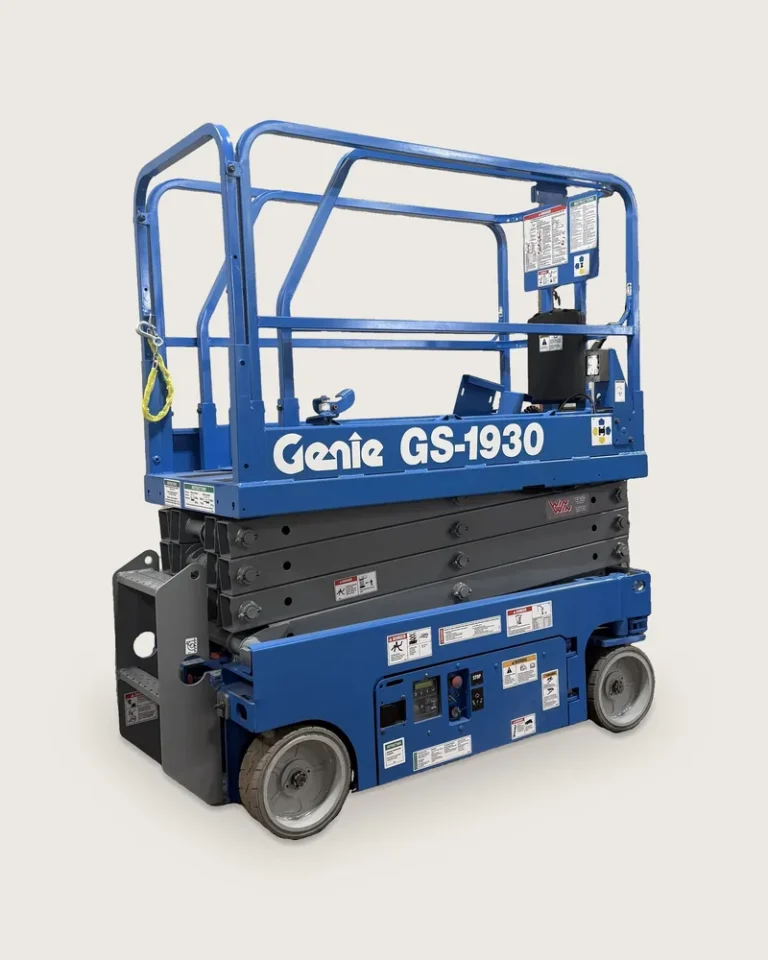
The Genie GS-1930 is the most common electric scissor lift in Chicagoland — which means we see more of them in our Addison shop than any other machine. We repair them, inspect them, and refurbish them down to bare metal. We pick yours up and diagnose it the same day; straightforward fixes go back the next day, and complex problems get an honest timeline before any work starts. Call 773-790-7299. This page covers the GS-1930 and its 32-inch sibling, the GS-1932.
Genie GS-1930 Service & Repair — GS-1930 quick service specs
The numbers a tech or owner actually looks up, from Genie’s service manual (P/N 1272217GT) for SmartLink-generation units:
| Battery pack | 4 × 6V, Group GC2, Type T-105 flooded (225 Ah) — or 6V-AGM maintenance-free option (200 Ah) |
| Battery weight | 62 lbs each |
| Hydraulic oil | AW46 hydraulic oil — our shop standard (Genie’s manual lists Chevron Rando HD ISO 32, an AW-type oil; low-temp fluid below 0°F) |
| Hydraulic tank / system | 3.4 gal tank / 3.8 gal system |
| Tires | 12 × 4.5 in solid rubber, non-marking |
| Wheel castle nut torque | 300 ft-lbs dry / 225 ft-lbs lubricated |
| Platform capacity | 500 lbs |
| Lift / lower time | 15–17 sec up; 18–30 sec down depending on configuration |
| Drive speed (stowed) | 2.5 mph max |
Spec sheet: every unit this page covers
| Spec | GS-1930 | GS-1932 |
|---|---|---|
| Deck width class | 30 in | 32 in |
| Platform capacity | 500 lbs | 500 lbs |
| Lift / lower time | 15–17 s / 18–30 s | 15–17 s / 18–30 s |
| Hydraulic system | 3.8 gal | 3.8 gal |
| Tires | 12 × 4.5 in solid | 12 × 4.5 in solid |
| Drive speed (stowed) | 2.5 mph | 2.5 mph |
| Gradeability | 25% | 25% |
Common GS-1930 problems — check these before you call
Won’t lift or won’t do anything: check the e-stops at both platform and ground controls (twist to reset), the ground/platform key switch position, and the batteries — a pack below ~24V nominal will drop functions before it dies completely. If the ground controls work but platform controls don’t, the problem is usually upstream of the joystick.
Won’t drive but lifts fine: on SmartLink units check the display for a drive-related code (H013–H021 family). The pothole guards are a classic culprit — if one is stuck, the machine inhibits drive while elevated and shows PHS.
Won’t charge: read the charger LED first. Solid red = internal charger fault (F-code — usually a replacement). Flashing amber = external problem (E-code — often battery voltage, connections, or a mismatched charge profile). The two we see constantly: E-0-0-4 (defective battery — the pack won’t trickle up to minimum voltage) and E-0-2-0 (no charge profile programmed, common after someone swaps a charger between machines).
Drifts down overnight: some settle is normal; a platform that visibly sinks in hours usually means the platform-down valve isn’t seating or the lift cylinder is bypassing — a shop job either way, and one we quote before touching.
GS-1930 display codes — status codes vs. fault codes
SmartLink-equipped GS-1930/1932 units (the generation with an LCD readout at the ground controls) show two very different kinds of codes. Status codes aren’t malfunctions — they’re the machine telling you why it’s refusing to move:
| Status code | What it means |
|---|---|
| LL | Machine is off-level — move to firmer/flatter ground |
| OL | Platform overload |
| PHS | Pothole guard stuck — check under the machine for debris |
| CH / CHrgr | Charger connected — functions limited while plugged in |
| nd | No-drive option active |
| br | Drive brake manually released — drive and lift disabled until reset |
| LoHt / OHL | Lift height limited (CE/AS models / outdoor height restriction) |
Fault codes (DTCs) mean the system found an electrical problem. There are 133 of them across five families — H (hydraulic-function circuits), P (power devices), U (switches and joystick), F (sensors and limit switches), C (control modules). The ones that put GS-1930s on our truck most often:
| Code | Meaning | Effect |
|---|---|---|
| H001–H003 | Platform up #1 circuit short/open | No lift |
| H013–H021 | Drive forward/reverse circuit short/open | No drive in that direction |
| H067–H072 | Motor controller enable/throttle circuit fault | Everything inhibited except platform down |
| H078–H081 | Platform down / steer circuit fault | That function inhibited |
| P001 / P003 | Switched power #1 circuit short (down limit, pothole or tilt switch harness) | All functions inhibited |
| U033–U035 | Drive joystick out of calibration range or shorted | No drive/steer from platform |
| U037–U039 | Foot switch pressed at startup, mis-wired or shorted | All functions inhibited |
| F005 | Pothole limit switch short | Down only while elevated |
| F007 | Chassis tilt switch short | Down only while elevated |
| F010 / F011 | Platform height sensor short | Down only while elevated |
| F034–F036 | Height sensor out of calibration | All functions inhibited — needs recalibration |
| F129 | Universal tilt sensor mismatch | All functions inhibited — sensor replacement |
| C021 | Platform controls not detected (CAN failure) | All functions inhibited |
| C025 | Platform overload system not calibrated | All functions inhibited |
| C058 | Drive controller voltage out of range (charger connected or batteries low) | All functions inhibited |
| C061 / C063 | Motor controller power or CAN communication fault | All functions inhibited |
Got a code that isn’t here — or an older non-SmartLink GS-1930 without a display? Call 773-790-7299 with the serial number and whatever the machine is showing. Older units use different diagnostics, and we work on every generation.
Charger codes: F means the charger, E means the batteries (usually)
The onboard smart charger has its own codes. F-0-0-1 through F-0-0-5 are internal charger faults: disconnect AC and the battery pack for 30 seconds; if the code returns, the charger gets replaced. The E-series points outward: E-0-0-1/E-0-0-2 battery voltage too high/low, E-0-0-3 charge timeout (often a deeply discharged or dying pack), E-0-0-4 defective battery, E-0-0-7 amp-hour limit exceeded, E-0-1-2 reverse polarity, E-0-1-3 wrong charge profile for the battery type, E-0-2-3/E-0-2-5 AC supply problems (undersized generators trigger this one on job sites). One detail that bites people: if you switch between flooded and AGM batteries, the charger profile must be reprogrammed — flooded packs use profile P001/P003, AGM uses P043. We handle that during service and every battery replacement.
Annual inspection for the GS-1930
Every GS-1930 in service needs its annual ANSI/OSHA inspection — no more than 13 months after the last one. $225 in our shop, $350 on-site anywhere in Chicagoland, same-day certificate when pre-scheduled, and we log your renewal date and remind you before the next one is due.
Pricing and turnaround
Repairs run $150/hr plus parts, quoted after a same-day diagnosis and approved by you before work starts. Batteries, tires, chargers, control boxes and joysticks are stocked or fast-ordered — the GS-1930 is our bread and butter. If a repair estimate crosses roughly half the value of the machine, we’ll tell you straight and show you what a refurbished GS-1930 costs with new batteries, tires, charger and a fresh inspection already on it.
GS-1930 acting up? Same-day diagnosis.
Call 773-790-7299 or request service.
Manufacturer specs and support: Genie, Skyjack and JLG.
GS-1930 service FAQ
What batteries does a Genie GS-1930 take?
Four 6-volt Group GC2 batteries — T-105 flooded (225 Ah) standard, with an AGM maintenance-free option. Remember the charger profile has to match the battery type. We install Crown deep-cycle batteries to this spec — a US-built pack that outlasts the cheap imports.
What hydraulic oil does it use?
AW46 hydraulic oil is our shop standard (Genie’s manual lists Chevron Rando HD ISO 32, an AW-type oil). Tank holds 3.4 gallons, full system 3.8.
My GS-1930 shows LL and won’t lift — is it broken?
Probably not. LL is a status code: the machine thinks it’s off-level. Move it to flat ground. If it persists on a level floor, the tilt sensor needs attention.
Do these codes apply to my older GS-1930?
The DTC tables apply to SmartLink-equipped units (LCD at the ground controls). Older machines use different diagnostics — call with your serial number and we’ll know exactly what you have.
Do you service the GS-1932 too?
Yes — same platform, same parts, same page. And the rest of the GS line: see Genie scissor lift service.
Spec and code data: Genie Service & Repair Manual P/N 1272217GT (Rev E1) for covered serial ranges. Trademarks belong to their owners; Win Win Equipment is an independent service shop.
Get your GS-1930 fixed: call 773-790-7299 (Mon–Fri 7am–3pm) or request service online. Also see: service hub · annual inspection · GS-1930 vs SJIII3219.